Tip: move over the painting to use the lens.
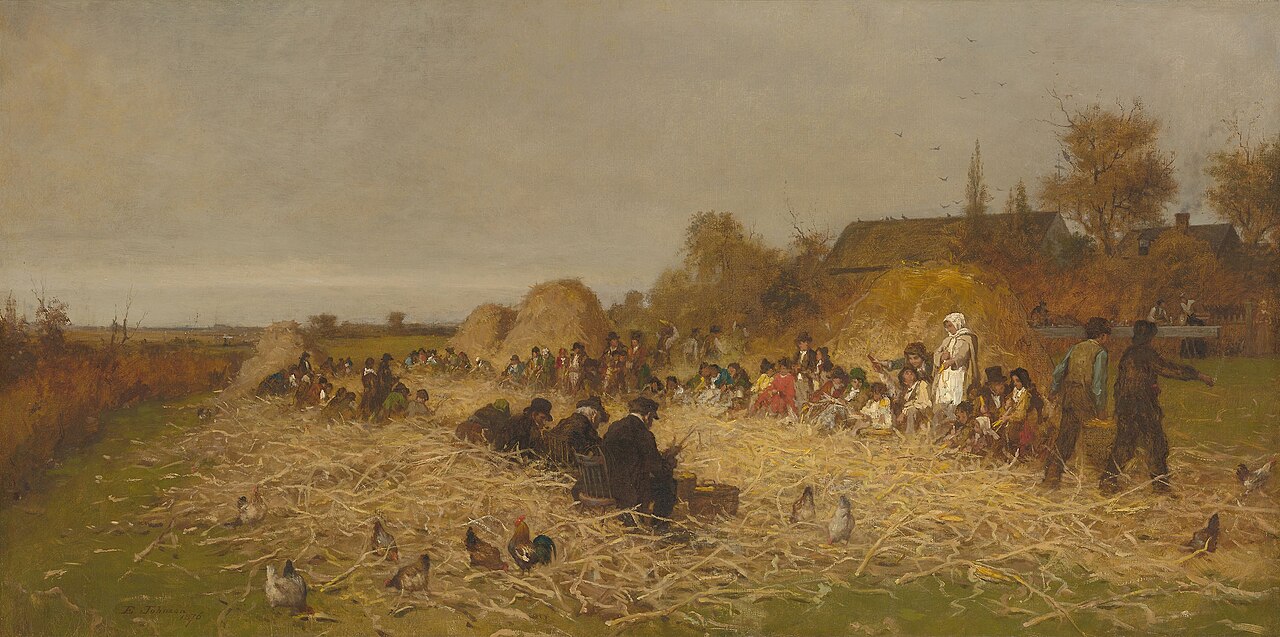
Husking Bee, Island of Nantucket
Eastman Johnson · 1876
- Artist
- Eastman Johnson (American, 1824–1906)
- Date
- 1876
- Medium
- Oil on canvas
- Size
- 69.6 × 138.2 cm (27 3/8 × 54 3/8 in.)
- Made in
- Nantucket Island
- Style
- Realism
- Where to see it
- Art Institute of Chicago
Gift of Honoré and Potter Palmer · CC0 Public Domain · Art Institute of Chicago · image via Wikimedia Commons · see it at the museum ↗
Notes from the museum
Eastman Johnson painted this composition in 1876, 100 years after the founding of the United States. The centennial fostered a sense of nostalgia among some residents as industrialization and urban growth rapidly transformed the nation. Husking Bee, Island of Nantucket depicts a seasonal gathering on the rural Massachusetts island. Community members work together to shuck corn and ready the harvest, a traditional activity that was far removed from daily life for many in the late 19th century. Johnson employed a warm palette and loose brushwork to describe this agrarian subject, presenting an uncomplicated vision of cooperation and closeness to the land.
Text: Art Institute of Chicago (open access). Our full story for this work is coming soon.
Slow Look
- The whole picture Let your eyes wander. Where do they want to rest?
- The light Find the brightest spot. What is it showing you?
- The edges Look at what is half cut off at the borders.
- One small detail Choose one tiny thing and stay with it for a while.
- The whole picture again Step back. Has it changed for you?
About Eastman Johnson
Jonathan Eastman Johnson was an American painter and co-founder of the Metropolitan Museum of Art, New York City, with his name inscribed at its entrance. He was best known for his genre paintings, paintings of scenes from everyday life, and his portraits both of everyday people and prominent Americans such as Abraham Lincoln, Nathaniel Hawthorne, Ralph Waldo Emerson, and Henry Wadsworth Longfellow. His later works often show the influence of the 17th-century Dutch masters, whom he studied in The Hague in the 1850s; he was known as The American Rembrandt in his day.
What do you see?
Stand in front of it for a moment. Then tell us what you noticed or felt - there are no wrong answers.
Be the first to share a thought.
If you like this, stand in front of these