Tip: move over the painting to use the lens.
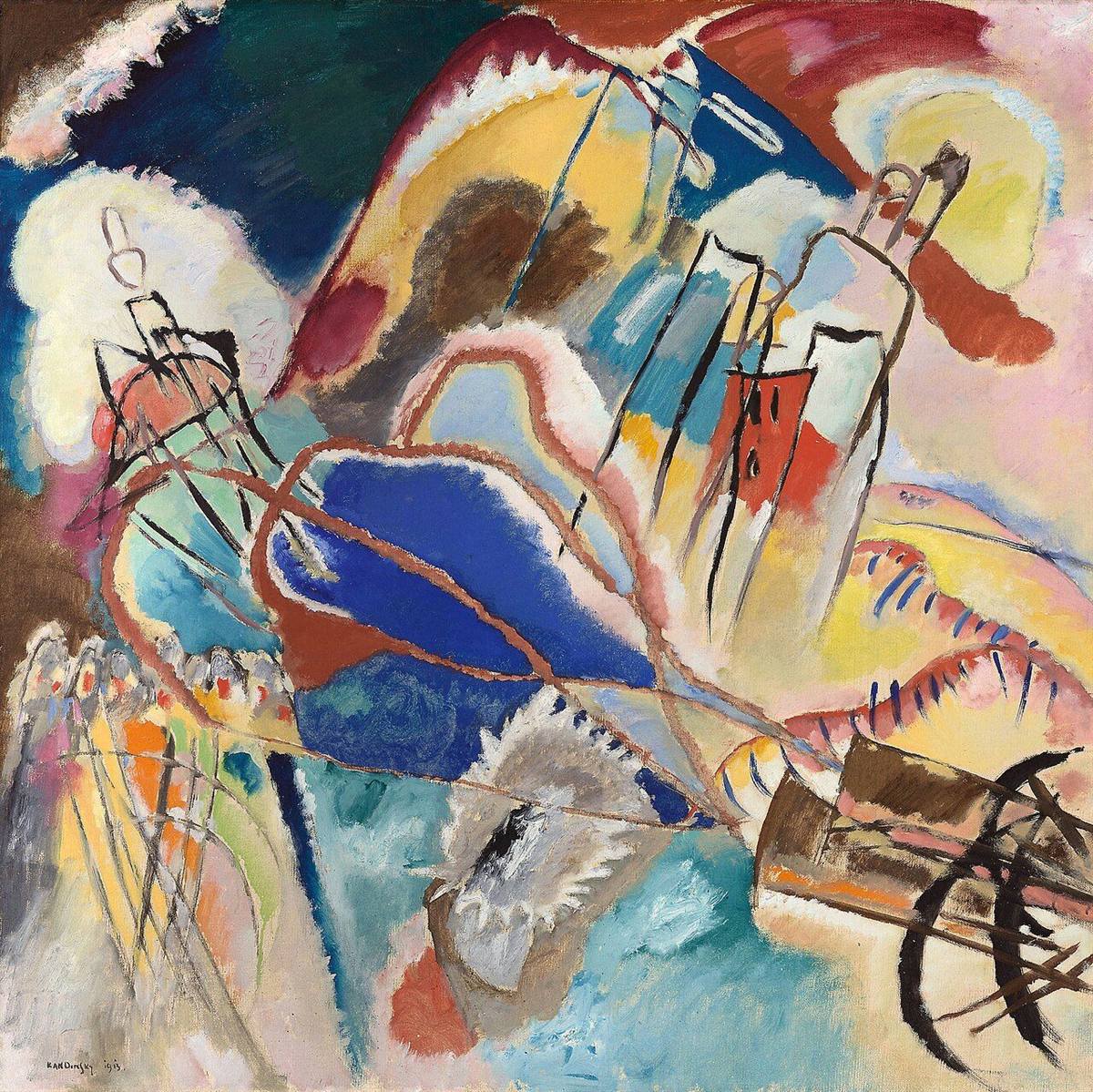
Improvisation No. 30 (Cannons)
Vasily Kandinsky · 1913
- Artist
- Vasily Kandinsky Born Moscow (formerly Russian Empire, now Russia), 1866; died Neuilly-sur-Seine, France, 1944
- Date
- 1913
- Medium
- Oil on canvas
- Size
- 111 × 111.3 cm (43 11/16 × 43 13/16 in.)
- Made in
- Germany
- Style
- Modernism
- Where to see it
- Art Institute of Chicago
Arthur Jerome Eddy Memorial Collection · CC0 Public Domain · Art Institute of Chicago · image via Wikimedia Commons · see it at the museum ↗
Notes from the museum
In his 1912 book Concerning the Spiritual in Art , Vasily Kandinsky made an analogy between music and painting as two means of abstraction, a radical mode of artmaking that freed color and line from their traditionally representational functions. Between 1910 and 1914 he produced “improvisations,” works he described as unconscious, spontaneous expressions. Kandinsky commented on Improvisation No. 30 (Cannons) in a letter to Arthur Jerome Eddy, a friend and collector from Chicago: “The cannons . . . could probably be explained by the constant war talk going on through the year [but] the true contents are what the spectator experiences while under the effect of the forms and color combinations of the picture.”
Text: Art Institute of Chicago (open access). Our full story for this work is coming soon.
Slow Look
- The whole picture Let your eyes wander. Where do they want to rest?
- The light Find the brightest spot. What is it showing you?
- The edges Look at what is half cut off at the borders.
- One small detail Choose one tiny thing and stay with it for a while.
- The whole picture again Step back. Has it changed for you?
About Vasily Kandinsky
Wassily Wassilyevich Kandinsky was a Russian painter and art theorist active in Germany during the late Belle Époque and Interwar eras. Kandinsky is generally credited as one of the pioneers of abstraction in Western art. Born in Moscow, he began painting studies at the age of 30.
What do you see?
Stand in front of it for a moment. Then tell us what you noticed or felt - there are no wrong answers.
Be the first to share a thought.
If you like this, stand in front of these