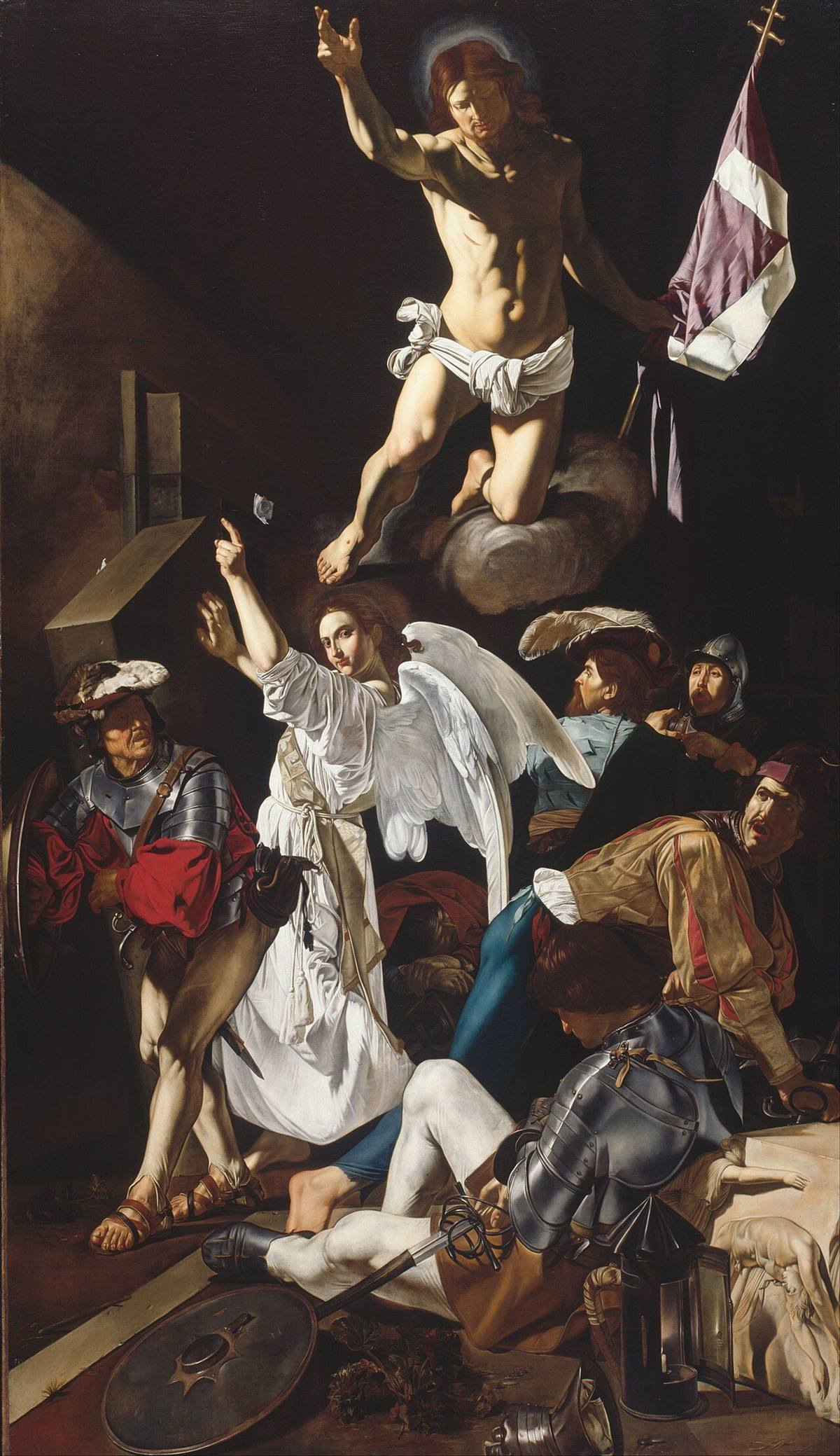
Tip: move over the painting to use the lens.
The Resurrection
Cecco del Caravaggio · c. 1619-20
- Artist
- Cecco del Caravaggio (Francesco Boneri; Italian, 1588/90–after 1620)
- Date
- c. 1619-20
- Medium
- Oil on canvas
- Size
- 339.1 × 199.5 cm (133 1/2 × 78 1/2 in.); Framed: 389.9 × 246.4 × 10.2 cm (153 1/2 × 97 × 4 in.)
- Made in
- Italy
- Style
- 17th Century
- Where to see it
- Art Institute of Chicago
Charles H. and Mary F. S. Worcester Collection · CC0 Public Domain · Art Institute of Chicago · image via Wikimedia Commons · see it at the museum ↗
Notes from the museum
Francesco Boneri was one of the closest followers of Caravaggio, the groundbreaking and influential painter of the Italian Baroque period. Boneri may have assisted and modeled for Caravaggio during the elder painter’s last years in Rome, a personal connection suggested by his contemporary nickname, Cecco (a diminutive of Francesco ) del Carravaggio. The Resurrection exaggerates the bold contrast of light and dark and the realistic treatment of sacred figures that were hallmarks of Caravaggio’s revolutionary style. The only documented painting by Boneri, this work was commissioned in 1619 by the Tuscan ambassador to Rome, Piero Guicciardini, for his family’s chapel in Florence. For reasons lost to history, the painting was rejected, a not uncommon event in Rome’s rapidly evolving art scene. It was eventually sold to another important collector, Cardinal Scipione Borghese.
Text: Art Institute of Chicago (open access). Our full story for this work is coming soon.
Slow Look
- The whole picture Let your eyes wander. Where do they want to rest?
- The light Find the brightest spot. What is it showing you?
- The edges Look at what is half cut off at the borders.
- One small detail Choose one tiny thing and stay with it for a while.
- The whole picture again Step back. Has it changed for you?
About Cecco del Caravaggio
Cecco del Caravaggio is the Notname given to a painter who worked in Rome in the early decades of the 17th century and was an important early follower of Caravaggio (1571–1610). In the past, art historians have suggested he may have been a Flemish, French or Spanish Caravaggist but more recently some have identified the artist with Francesco Boneri, although this is not universally accepted. In his work the artist responded in a very individual and original manner to Caravaggio's naturalism.
What do you see?
Stand in front of it for a moment. Then tell us what you noticed or felt - there are no wrong answers.
Be the first to share a thought.
If you like this, stand in front of these